


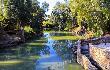
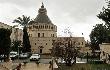
The "Well of Mary" in Nazareth is the first spring we will visit. The water from this spring is considered sacred among Christians.
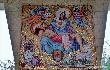
The Church of the Annunciation is another significant site in Nazareth. Thanks to the Roman Emperor Constantine the Great and his mother Helena, churches marking the key events in the Gospels were built in the Holy Land: the Church of the Nativity in Bethlehem, the Church of the Holy Sepulchre in Jerusalem, and the Church of the Annunciation in Nazareth. The modern church was constructed in 1969 and is the largest Catholic church in the entire Middle East. On the lower level of the church, there is a grotto believed to be the place where the Virgin Mary received the Annunciation. Pay attention to the frescoes, which have miraculously preserved their original appearance. Another unique feature of the church is the frescoes, icons, and images of saints donated to the church from various corners of the world. Since ancient times, pilgrims have brought water from this spring back to their homelands, considering it to be miraculous.
Nazareth, the third most important city for Christians after Jerusalem and Bethlehem, is where Jesus Christ spent his childhood and youth. According to one version, the name Nazareth comes from the Hebrew word "nezer," meaning branch. It was once a small agricultural settlement, home to just a dozen families, including the Holy Family. One of the significant Christian holy sites in Nazareth is the Grotto of the Annunciation, upon which the Church is built. In the vicinity of the city, you can find the National Park of Sepphoris, the parental home of Mary, as well as the ruins of a Crusader fortress and other archaeological attractions. Jesus is often referred to as "ha-Notzri," meaning the Nazarene, because of his connection to this place.
Cana of Galilee, the site of Jesus' first miracle, is a well-known settlement in Galilee. It is where Jesus turned water into wine, as described in the Gospel of John. During a wedding feast in Cana, this miracle took place. We will also have the opportunity to taste wines there.
The Jordan River is the most sacred waterway in both Western and Eastern Christianity, as it is where Jesus Christ was baptized by John the Baptist. Stretching 232 kilometers, the Jordan River originates at the foot of Mount Hermon, passes through the Sea of Galilee, and flows into the Dead Sea. It is remarkable that the river valley was once covered by tropical forests, and hippopotamuses inhabited its coastal marshes. The river is mentioned multiple times in the Old and New Testaments. Today, it serves as a border between Israel and Jordan. Pilgrims and tourists from all over the world gather at the river to immerse themselves in its sacred waters. On the Israeli side, the baptismal ritual can be performed at the Yardenit complex.
Magdala is an ancient Galilean city and the hometown of Mary Magdalene. According to the Bible, Mary Magdalene is the second most important woman in the life of Jesus Christ. Magdala is home to three springs. The first spring, known as the "eye spring," is not used for baptism but for collecting water to take with you. According to tradition, it helps people with vision problems. The second spring is a radon spring. The third spring is the one from which Jesus Christ healed Mary Magdalene and is suitable for baptism.
Departure days
Departure days depend on your departure city
Info
Conditions for order cancellation:
If a tourist cancels an excursion in less than 3 days – penalty 100% if "No Departure Insurance" is purchased.
Money is returned only if "No Departure Insurance" is available.
Important:
- People who are late and do not go on the excursion will not receive a refund.
- The company is not responsible for lost items.
- Requests for excursions for children under 5 years old are not accepted
- Responsibility for having an individual insurance policy falls on the tourist.
- Tourists may wait up to 30 minutes for the bus.
- The company reserves the right to change the departure time for the excursion, which is communicated to the tourist the day before.
- There is no indication of seats on the bus. Boarding and disembarking carried out only in designated places.
- Visiting holy places is permitted only in modest clothing (shoulders and knees must be covered).
- Physical activity level: 3/5
We recommend: bring drinking water, a hat, sunglasses, swimwear, and comfortable shoes with you on the excursion.
The cost of trips does not include and is paid on the spot: meals, unless purchased additionally.
Attractions
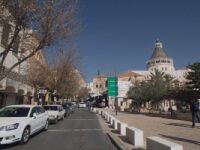
Nazareth, is the third most important city for Christians after Jerusalem and Bethlehem, here the childhood and youth of Jesus Christ passed. Nazareth got its name from the Hebrew word "netzer" - a branch, although in modern Hebrew this word is not used to denote a branch. Nazareth was first mentioned in the Gospel.
According to archaeological excavations, there used to be an agricultural settlement, where only a few families lived, including the holy family (the Blessed Virgin Mary, Joseph and Jesus Christ). The significant Christian shrine in Nazareth is undoubtedly the grotto of the Annunciation, over which the Temple of the Annunciation was erected. In the vicinity of the city there are: Sepphoris National Park - the parental home of Mary, the remains of the Crusader fortress and other archaeological sites.
It is because of this that Jesus is called “ha-Nozri,” which means Nazarene.
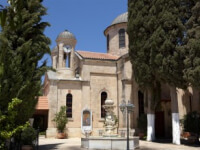
It is a small Arab settlement. Here happened a miracle known to us from the biblical story , created by Jesus - at the wedding, he turned water into wine, deciding to help the newlyweds at the request of the Mother. Now on this place is the Catholic Temple of the Lord’s wedding. It is believed that the marriages concluded in this Temple are the strongest and happiest. Also in Cana of Galilee you can see the Church of St. George the Victorious and the Church of the Holy Apostle Bartholomew.
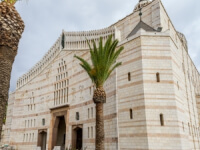
Thanks to the Roman emperor Constantine the Great and his mother Elena, were built churches on the territory of the Holy Land celebrating the main gospel events: the Church of the Nativity in Bethlehem, the Church of the Holy Sepulcher in Jerusalem and the Church of the Annunciation in Nazareth. According to the Christian tradition, Mary lived here exactly when the archangel Gabriel announced the good news about the birth of the messiah, thats why this place it seems to be unique.
The modern church was erected in 1969 and is the largest Catholic church in the entire Middle East. The church consists of two levels, the lower level is the grotto, where, upon giving, was Virgin Mary during the Annunciation. You should pay attention to the frescoes that have come down to us from the past and miraculously preserving their almost original appearance.
In the grotto there is a throne with a marble circle, where the message is written in Latin: "Verbum caro hic factum est" - "Here your word has become flesh."
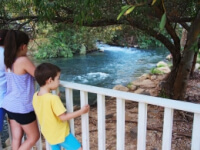
Jordan is a river in the Middle East, considered being one of the most sacred rivers in the world.
Jordan originates at the foot of the Mount Hermon, flows through the Sea of Galilee, and runs into the Dead Sea. In its downstream it represents a natural border between Israel and Jordan.
Jordan is frequently mentioned in the Bible. According to the Old Testament, the Jewish people with Joshua crossed Jordan on dry land while its waters parted by miracle, thus completing the forty-year-long wandering of the Jews in the desert. Later, according to the Gospel, Jesus Christ was baptized in the waters of this river.

Magdala is an ancient Galilean city located in modern-day Israel, mentioned in the Bible as the hometown of Mary Magdalene.

The well is located at the site where the Archangel Gabriel appeared to the Virgin Mary and announced that she would give birth to the Son of God, an event known as the Annunciation.
The well, discovered beneath the Greek Orthodox Church of the Annunciation in modern-day Nazareth, was situated above an underground spring that served as the main water source for the residents of Nazareth for many centuries.
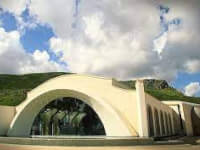
Magdala is an ancient Galilean city located in present-day Israel, mentioned in the Bible as the hometown of Mary Magdalene.
The city is situated on the shores of the Sea of Galilee (also known as the "Lake of Gennesaret" and the "Sea of Tiberias"), at the southern end of the fertile Plain of Gennesaret, in the former territory of the tribe of Naphtali, not far from Capernaum.
Currently, near the site of the historical Magdala, there is the Arab village of Al-Majdal and the Jewish settlement of Migdal.
Feedback
-
 - Hotel 1 ($)
-
 - Hotel 2 ($)
-
 - Rally point (₪)
-
 - Rally point 2 (₪)